BEHIND THE SCENES OUR PERU ORIGIN TRIP
TRAVELLING PERU WITH CHOCOLATEMAKERS
HIGHLIGHTS – INSIGHTS – LESSONS LEARNED – FORESIGHT
In July, we travelled through northern Peru with a group of chocolate makers. Over eight days, we met the people behind some of SILVA Cacao’ s Peruvian cacao, visited farms and cooperatives, tasted cacao at source and got a closer look at the work behind the quality and flavours -from genetics and farming to fermentation, drying and chocolate making.
The journey took us from Lima to the cloud forests of Chachapoyas to the cacao communities around Bagua, Jaén and San Ignacio. With every stop, we discovered another part of the story: Peru’s remarkable diversity, its deep cacao history, the people working to preserve it and the changing conditions that are challenging the current crop and may shape the next one.
17-25 July 2026 · Lima → Chachapoyas → Bagua → Jaén → San Ignacio

✨ HIGHLIGHTS ✨
➤ What we saw, did, tasted and experienced; the people, places, farms, cooperatives and cacaos that shaped the journey.
Our journey began in Lima, at Peru’s Salon del Cacao y Chocolate Internaciona -a meeting point for producers, chocolate makers, buyers and professionals from across the sector. It was the perfect opportunity to reconnect✨ with our partners, catch up with old friends and meet new faces before heading north towards the heart of Peru’s cacao-growing regions.
From Lima, we flew to Chachapoyas, high in Peru’s cloud forest at around 2,334 metres, before continuing by road towards Bagua and the cacao-growing valleys of Amazonas -an area closely connected to the origins and diversity of Peru’s native cacao.
In Bagua, we spent time with APROCAM -a cooperative that has been close to SILVA CACAO’s heart for many years. Around 256 farmers are part of the cooperative, approximately 60% of them from the Awajún indigenous community✨.
APROCAM cultivates cacao within agroforestry systems, including plots over 60 years old that remain productive today, while continuing to strengthen its focus on quality, sustainable production and opportunities for the next generation.
We met up with Freddy, Santos, Rosilio and the team behind the cacao and saw their work first-hand -from quality grading and chocolate making to creating new opportunities for young people in cacao. A real highlight✨ was celebrating APROCAM’s Silver Award in the 2025 Cacao of Excellence Awards with the whole team, recognising the quality of their cacao among the highest-ranking producers..
Alongside this, we tasted the new harvest Lagunas✨, one of the Peruvian organic cacaos we work with from the wider Bagua area. Its profile is beautifully rounded, with peach and hazelnut and a delicate violet note at the end. Lagunas is another expression of the rich native cacao heritage of Amazonas, a region that is home to the protected Denominación de Origen “Cacao Amazonas Perú”.

We then travelled deeper into Amazonas, to Chiriaco and the village of Pakun, where we met members of the Awajún community and visited cacao farms.
The next day, we continued to Lhuana and our own 1.6 ha cacao farm. The jungle had a surprise waiting for us: a striking red-crested woodpecker✨ appeared among the trees.
Seeing cacao growing in this environment adds another dimension to its origin -connecting the bean to the landscape, the people and the traditional knowledge that surround it.

We continued our journey through Amazonas to Bagua Grande, where we visited the CEPROAA cooperative and met up with ✨ Cily, Milton, Nayeli and the team.
Around 251 producer families are connected to the cooperative, with 188 organically certified. A smaller group of around 40 works with native cacao genetics, including heirloom red and yellow Criollo varieties from the region.
The cooperative’s dedication to post-harvest✨ is particularly impressive. A specific protocol is used to preserve the delicate character of the native cacao, with careful attention to fermentation, pre-drying and drying -showing just how much the final flavour depends on what happens after the cacao leaves the tree.

The work at CEPROAA goes beyond the bean itself. The cooperative is developing ways to create additional value locally, from upcycling cacao by-products into flour and producing bio-fertilisers, to its chocolate laboratory, where its own cacao is transformed into finished products under the UTKKU brand✨ .
The result is more than a cacao supply chain. It is a broader approach to value creation at origin, keeping knowledge, processing and opportunity within the community.
Further north, close to the Ecuadorian border, we reached San Ignacio in the Cajamarca region, where we met up with✨Noe, Norbil and the team behind Oro del Chinchipe. The cacao comes from producer families in the San Ignacio area and is based entirely on Nacional and Marañón genetics.
Their work goes beyond the bean itself. The team is also focused on protecting and preserving this genetic heritage✨, helping to safeguard cacao material that is particularly distinctive to this part of northern Peru.
Our journey ended near Jaén, at Montegrande, an archaeological site linked to the Mayo-Chinchipe-Marañón culture. Guided by Dr. Quirinio Oliveira, we explored the site’s significance for understanding the early history of cacao and its importance to the communities✨ that have lived in this region.
From chocolate makers and producers in Lima to farms, cooperatives, native communities and ancient archaeological sites, the journey gave us a close-up view of the people, cacao and landscapes behind northern Peru’s remarkable diversity✨.

💡 INSIGHTS 💡
➤ What we learned along the way about Peru’s cacao -the crop, climate, flavour diversity and the realities of production.
💡 THE 2026 HARVEST IS NOT ONE STORY
Our partners are seeing smaller main-crop volumes this year, while early indications for the later secondary crop are more encouraging.
When we travelled through Amazonas and northern Cajamarca in July, the main harvest was already well underway. But the picture was not the same everywhere: harvest timing, volumes and conditions differ between producing regions.
For Peru, there is therefore no single crop story. The 2026 harvest is developing differently from one area to another.
💡 EL NIÑO WAS IMPOSSIBLE TO IGNORE
During our journey in early July, the effects of El Niño Costero were part of the wider conversation around agriculture in Peru. Coastal waters had been unusually warm, with weather disruption affecting fishing, agriculture and infrastructure, while heavy rains and flooding had added further pressure in some areas.
The cacao-growing areas we visited in Amazonas and northern Cajamarca lie outside this coastal zone, so they were not experiencing the same conditions.
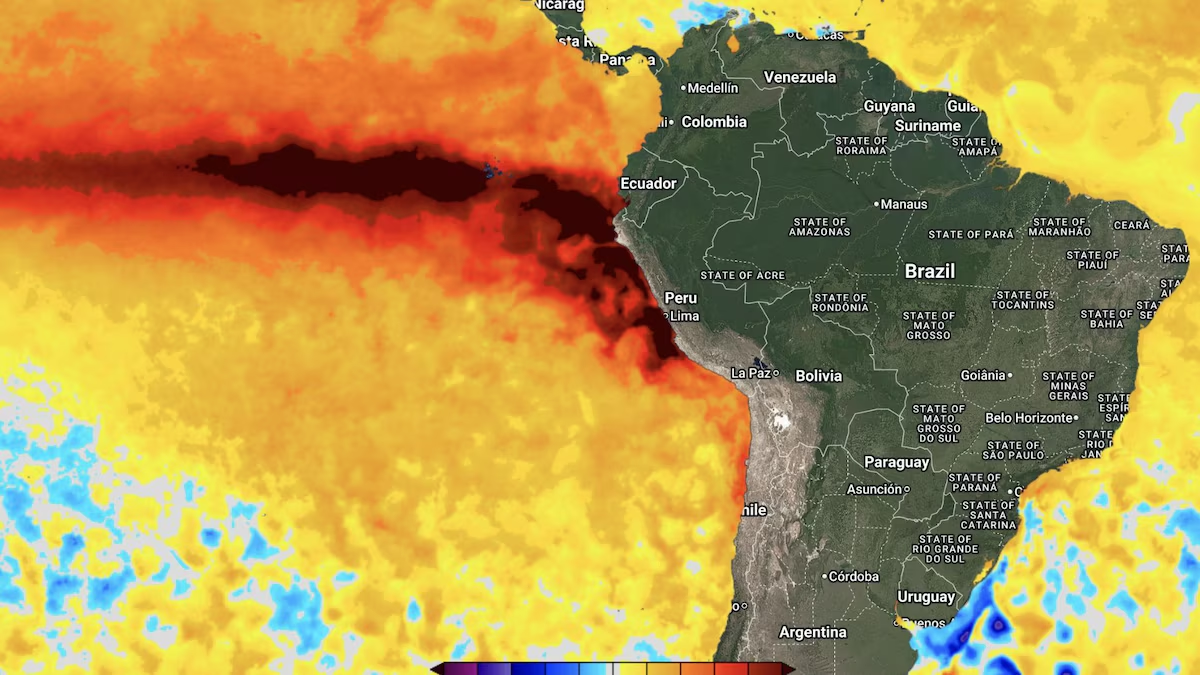
A broader El Niño in the central Pacific is now developing, with forecasts pointing to a potentially very strong event in late 2026 and early 2027. Unlike El Niño Costero, this is a large-scale climate phenomenon that can influence weather patterns across Peru, including its inland cacao-growing regions. What this will mean for cacao will depend on the region, timing and local conditions.

But the relevance goes beyond Peru. There is relatively little buffer against a strong El Niño: many of the world’s major cacao-producing regions can be affected by the associated weather patterns. For those sourcing cacao, this is another reminder that climate risk is not confined to one origin or one harvest. The Peru story shows how conditions can vary from one region to another and from one season to the next, adding another layer of uncertainty to cacao sourcing.
💡 PERU’S FLAVOUR DIVERSITY IS VERY REAL
Travelling from Bagua to San Ignacio made Peru’s flavour diversity tangible. Along the way, we tasted very different expressions: Lagunas, with notes of peach, hazelnut and violet; UTKKU cacao, with its delicate flavour profile; and Oro del Chinchipe, with expressive floral notes of rose, jasmine and lychee.
But along the same route, you can also find Peruvian cacao with more standard genetics, less developed post-harvest protocols and more conventional flavour profiles. From highly distinctive flavour profiles to much more conventional ones, the diversity is striking.
Peru’s remarkable genetic richness, particularly in the north, is an important part of this story. DNA fingerprinting has made it possible to map this diversity in much greater detail and identify distinct genetic groups. The work began with the genetic classification developed by Motamayor et al. in 2008 and has since been refined through further research in Peru, including studies using SNP markers. One of the groups identified, Cajamarca-Amazonas, is particularly relevant to this journey: it is associated with native cacao from Bagua, Jaén and San Ignacio.
But genetics are only part of the picture. Growing conditions and, importantly, post-harvest work determine how that genetic potential is expressed. Today, 75% of Peru’s cacao bean exports are classified by the ICCO as fine or flavour cacao, under the current ICCO classification.

For chocolate makers, this diversity matters: different genetic backgrounds, growing environments and post-harvest approaches can lead to genuinely different flavour expressions.
💡 ORGANIC TAKES MORE WORK AT ORIGIN
In Peru, we also saw what the tighter organic requirements mean in practice. Organic lots need stronger evidence behind them, including laboratory testing, while full-farm organic status and contamination risks from neighbouring conventional plots add further challenges for smallholder farmers and their cooperatives.
For cooperatives working with many smallholders, this means more attention at origin to control, verify and protect the organic status of each lot.

And this is not only a Peru issue. It is increasingly relevant for cacao from every origin entering the European market
🧠 LESSONS LEARNED 🧠
➤ What the journey made us see more clearly, and what it reinforces about understanding, sourcing and staying close to origin
🧠 DIVERSITY BUILDS RESILIENCE
Climate volatility makes it increasingly difficult to rely on one region, one crop or one genetic profile. Working across different origins, regions and genetic backgrounds gives us more options when conditions change.
The Peru journey reinforced the value of that multi-origin, multi-region approach: conditions can vary significantly from one producing area to another, while different cacao profiles give chocolate makers alternatives when availability or quality shifts.
Diversity is not only about choice. It is also about having options when conditions change.
🧠 RELATIONSHIPS MATTER MOST WHEN CONDITIONS ARE DIFFICULT
Meeting our partners in person makes the value of long-term relationships tangible. Being close to origin gives us context that market information alone cannot: a better understanding of what is happening with the crop, quality, availability and the realities behind the numbers.
But relationships are not only about understanding. They create the foundation for working through difficult seasons together.
For cooperatives and smallholder farmers, long-term partnerships, forward planning and committed relationships with buyers can provide greater confidence to invest in quality, post-harvest practices and the future of cacao -even when a harvest is smaller or conditions become more challenging. This is where responsible sourcing goes beyond a transaction: it is about building relationships that support quality and resilience over time.
For us, staying close to origin means understanding not only what is available today, but also what may be possible tomorrow. That first-hand understanding becomes particularly valuable when conditions change or a harvest does not go according to plan.

🧠 FROM ORIGIN TO IDENTITY
The journey reinforced how much more there is to know behind a country name. A cacao’s origin can be understood through many layers -its region, landscape, community, farm and genetic background. Farming practices and post-harvest work add further dimensions, all contributing to how a cacao develops and expresses itself.
For specialty cacao, understanding these layers matters. Traceability should go deeper than simply knowing that a bean comes from Peru. Knowing its regional and genetic identity helps us understand what makes it distinctive and can also help protect native cacao populations and genetic diversity that could otherwise disappear.
Travelling through northern Peru made this tangible. Within one country, we encountered very different cacao identities shaped by their place, genetics, people and post-harvest practices.

🔭 FORESIGHT 🔭
➤ What could matter tomorrow when changing crops, weather and limited specialty volumes make understanding the origin & planning ahead increasingly important.
🔭 A JOURNEY LIKE THIS IS NOT JUST ABOUT UNDERSTANDING WHAT IS HAPPENING TODAY
It is about seeing what may matter tomorrow.
For chocolate makers, the opportunity in Peru is not simply to find Peruvian cacao. It is to understand the different origins, genetic profiles, flavour expressions and partnerships within Peru -and to recognise which ones could become important for the future.
With weather patterns becoming less predictable and specialty volumes remaining limited, knowing where cacao comes from, how a crop is developing and what may be available next becomes increasingly valuable.
That does not mean trying to predict the market. It means staying close to origin, listening to our partners, understanding the crop as it develops and planning ahead when an interesting cacao or partnership emerges. Because the question is no longer only: “What can I buy today?” It is: “What do I want to secure for tomorrow”?

OUR PERU CACAO PORTFOLIO AT A GLANCE
AVAILABILITIES & PROFILES

➤ All lots EUDR-ready with GPS-linked farm data
➤ Organic certified where indicated
➤ Fairtrade certified where indicated
➤ Packaging (jute, GrainPro or PP; 50-65 kg) varies per lot
KUDO’S, CREDITS AND INSPIRATION
- Salón del Cacao y Chocolate – Peru
- cacaoofexcellence – Silver Distinction | Cooperativa Agraria APROCAM, Peru
- Nature – A revisited history of cacao domestication in pre-Columbian times revealed by archaeogenomic approaches
- ICCO
- Thomas, Lastra & Zavaleta (eds., 2023), Catálogo de Cacaos de Perú — Bioversity International / MOCCA
- Plos one – Genetic structure of traditional cacao reveals four new genetic lineages in indigenous Amazonian sites in Peru
- Nature.com – A revisited history of cacao domestication in pre-Colombian times revealed by archeaigenomic approaches
- Financial Times – Disruptive climate event is likely to be one of the strongest on record – How will El Niño hit the world economy?
- Financial Times – El Niño threatens to disrupt the world’s most-traded commodities
- Nasa Science – Warming Water and Downpours in Peru
- Nasa Science – El Niño Is Underway
- European Commission Joint Research Centre – Potentially historic El Niño to come
- Silva Cacao – Peruvian Cacao Symphony
- Silva Cacao – Everything You Always Wanted to Know about Cacao Genetics
- Silva Cacao – The Art of Cacao Sourcing
- Silva Cacao – To organic or not to organic – Understanding how the EU’s 2025 Rulebook shapes cacao value chains
Share This Story, Choose Your Platform!
Sign up for our newsletter and never miss any chocolate news anymore.